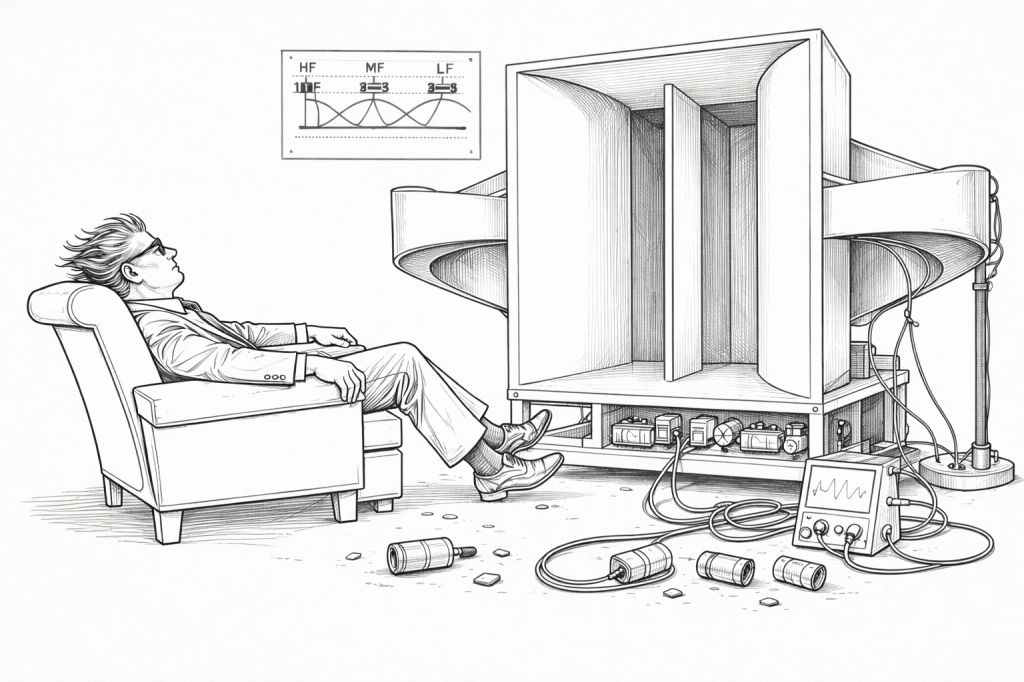
If what you want is plug-and-play, install-and-forget, press a button and feel clever… then let’s save everyone some time:
the big horn route is not for you. Especially not the large, old-school kind. Big horns don’t do convenience. They do commitment. And they invoice you in patience.
Bring a big horn into your room and accept this immediately:
it will not sound like what you heard before. Not at a show. Not at a friend’s place. Not even like what you swear you remember. A horn does not care about your memories. It listens to the room, shrugs, and does its own thing.
This is why many people stop progressing. Not because the next step is worse — but because they’re not emotionally prepared for “different.” Big horns don’t ease you in gently. They kick the door open and rearrange the furniture.
Then comes the classic reflex:
“Let’s go vintage.”
Copy a mid-to-late-1930s design. Or better yet, grab an original crossover, bolt it in, and announce online that you’ve “arrived.”
If the goal is authentic vintage, fair enough. Museum work is noble work.
But let’s not pretend it’s a performance shortcut.
After going down that road properly, 13Audio quietly left it years ago. Not because the past is bad — but because nostalgia stops being useful once you’ve measured enough times.
Now sprinkle in a weak setup — borrowed crossover points, slopes from another life, delay values chosen by hope rather than physics — and suddenly opinions go wild. One listener hears transcendence, another hears a crime scene. Almost always, this has nothing to do with the horn and everything to do with the setup. Excellent hardware gets blamed daily for crimes it did not commit.
Yes, there are high-end boxes with “the solution inside.” They may work. They offer reassurance. They whisper softly: don’t worry, it’s all been solved already. Audiophile comfort food.
Add to that online forums and endless email threads, overflowing with options, opinions, and absolute certainty. Crossovers, values, slopes, secret recipes — an abundance of solutions. And that’s exactly what they are: options, not conclusions. Most are not based on living with the system, in the room, over time. So yes — read them, listen to them… just don’t confuse noise with experience.
Here’s the inconvenient truth:
only a handful of people — not many, worldwide — have actually ironed out most of this work. They’ve measured, failed, listened, repeated, and lived with these systems long enough to know where the traps are buried. Working with people who have done that — including 13Audio — gives access to that accumulated experience. And yes, their advice is probably worth considering.
Now, to be fair, you can dive straight into the passive route if you want. Plenty of people do. Some even succeed. But let’s be honest: that’s faith, not method. Sometimes faith works. Sometimes it just looks confident.
The alternative is less romantic but far more effective: start active. Measure. Adjust. Move the crossover. Flip polarity. Add delay. Remove it again. Use the active route to discover what actually works here.
Then, once the numbers stop moving and the system stops arguing with you, translate those values into passive.
At that point, grab the chokes, capacitors, resistors, heat up the soldering iron — and game on.
Otherwise, you’ll stay exactly where you are, proudly convinced you’ve arrived… when in reality, you just stopped asking questions.
In short:
Big horns tell the truth, rooms have opinions, forums offer options, experience earns authority — and bad setup always gets blamed last.
 13Audio